


Rinsing Cans Before Filling: Is it Important?
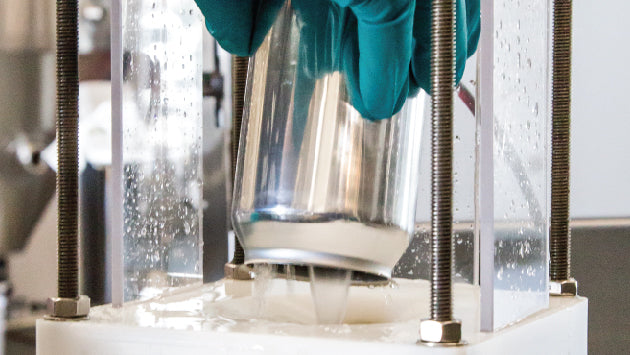

A question we often receive is: “Do I need to rinse my cans before filling?” The short answer is Yes. Probably. Rinsing cans before canning is a quick and worthwhile way to ensure no foreign contaminants spoil your canned beverage or make their way to your customer.

 Banded cans[/caption]
 Twist rinse[/caption]
 Gosling can rinser attachment[/caption]


José, do I need to rinse my cans?
Can manufacturers typically sterilize the cans they make. What happens after those cans leave the manufacturer’s facility is where you need to determine whether to rinse or not. Ask yourself these questions:1. Are my cans shipping to me straight from the can manufacturer?
When your pallets of cans arrive wrapped and intact directly from the original can manufacturer, you can be reasonably confident they are sterile. However, you may still decide to pre-rinse just in case, especially if they have sat awhile since you received them!
2. Will my cans route through a third party before they get delivered to me?
If you receive your cans from a third party (for instance, a company labels or shrink-sleeves the cans before shipping to you), you do not have any assurance the cans are sanitary. That third party is handling the cans: opening up the pallets to send cans through labeling or shrink-sleeving machinery and then repalletizing them. While these processes are usually fairly automated and carefully managed (meaning there aren’t a lot of hands touching the cans), the pallet has been split apart after leaving the original manufacturer and you do not know for sure what is in those cans anymore. At this point, it is a good idea to rinse your cans before you put them into your canning line. [caption id="attachment_6056" align="alignright" width="225"] Banded cans[/caption]
3. How long will my cans sit in storage before use?
Even if you get cans directly from the manufacturer, the longer those cans sit in your storage, the more likely they will pick up some debris.Pro tip: Assuming you will not use up an exact pallet of cans during your canning run, take measures to keep the remaining cans clean. When you leave partial pallets of cans in storage, save a clean slip sheet and the top frame so you can cover the exposed top layer of cans. If using a depalletizer, avoid wrapping the partial pallet of cans. Wrapping will bend the corners of the tier sheets between the layer of cans, which can cause problems for you during depalletization. Instead, use banding to hold your pallet together.
4. How confident am I with the sanctity of my storage area?
Consider this scenario: While sitting in storage, maybe your empty cans pick up a little bit of grain dust. If you choose not to rinse them before canning, this grain dust can impact your product. You do not want to end up with potential re-fermentation in your seamed cans – this is not worth the risk! To take it a step further, you can test your cans for certain kinds of contamination. Many breweries use ATP (adenosine triphosphate) swabs to check for living microbes or organic residue on equipment or hoses. Consider swabbing your cans to double check cleanliness before you put your product into them.What equipment do I need for rinsing cans?
There are a lot of ways you can rinse cans. I’ve seen some breweries get pretty creative with their setups! [caption id="attachment_6059" align="alignright" width="300"] Twist rinse[/caption]
Twist Rinse
If you are canning on a more automated canning machine like our Evolution Series, you can get a twist rinse. The twist rinse automates the rinse process, flipping the can upside down, rinsing it, and turning it right-side back up again before it goes into your canning system. Typically, you will have a depalletizer pushing your cans from their pallet onto a conveyor and into the twist rinse. A twist rinse can be a little messy, but it generally has an enclosure or drain to funnel the spray. [caption id="attachment_6057" align="alignright" width="200"] Gosling can rinser attachment[/caption]
Rinse Attachment
For breweries running one of our Gosling canning systems, we suggest the pre-rinse rinser attachment. It hooks up to your water supply or a keg of your rinse liquid. When you place the can upside-down into the rinser, a sensor triggers the rinse liquid. On the Gosling interface, you can set your rinse times. (Side note: If you have a higher pressure going through your keg of rinse fluid, you can program a pretty quick rinse: a quarter- to a half-a-second.)By Hand
Don’t forget about the good old-fashioned “Dunk and Shake” method! You dip the can into a container of rinse liquid and then shake it out so you do not leave too much residual fluid in the can.Pro Tip: No matter what type of rinsing you do, avoid sticking your fingers inside the cans. Even if you wear gloves (and I highly recommend it), gloved hands do not necessarily mean sanitized hands!
What substance should I be using to rinse?
Water
Generally speaking, you can just rinse with water. Filtered water or sterilized water that runs through a UV light is ideal. When rinsing cans using water, you don’t have to be as quite as careful to get every last tiny droplet out because beer and a lot of drinks are already majority water!Sanitizer
You could use a light sanitizer for rinsing cans I suppose, but you MUST keep in mind that most sanitizers are oxidizers. If you leave too much sanitizer behind in the can and then fill that can with your beer or whatever you are canning, you could potentially reduce the shelf life of your product. It will oxidize a lot quicker. You have to be very careful. In addition, consider some other quality control concerns when using sanitizer to rinse. For example, Iodophor, a common sanitizer used in breweries, kills your foam and tastes like pennies!Pro Tip: If you choose to rinse with sanitizer, use the lowest effective concentration of sanitizer. For instance, PAA lists a “most effective range” of 50ppm to 250ppm. 50ppm applies for can or bottle rinsing and 250ppm applies for tanks.
Ionized Air
The newfangled thing these days is using ionized air to rinse your cans. An ionized air setup is much more expensive than other methods. Cans get turned upside down similar to a twist rinse, but instead of liquid you are using specialized air to clear the can. A generator ionizes the air and blows it into the can. The ionized air neutralizes static electricity in the can to dislodge any little contaminants or debris clinging to the can. Then the air pulls out all the particles. It’s kind of like when you rub your feet on the carpet and then touch somebody to discharge the static electricity.If you blow normal air into the can, you might clear some of the bigger debris, but you are not doing anything to release particles stuck in the can by electrostatic charge. You want to be attacking that stuff, too!
Why couldn’t I just use regular compressed air?
What about using carbon dioxide (CO2) to clear out my cans?
I have come across breweries using CO2, but it’s not the norm. It will definitely increase your facility’s CO2 consumption! Blowing out a can with CO2 can remove some particulates hanging around (though not like ionized air). Some breweries do this to try to boost freshness, since CO2 displaces some oxygen before the can is formally CO2-purged and filled on your canning line, potentially reducing dissolved. Importantly though, consider the serious safety concerns of “rinsing” with CO2. This method increases the CO2 concentration in the air you breathe in your facility!
Can I recirculate my rinse liquid?
I would not advise it. Water gets dirty fast, and sanitizer is only effective for a certain amount of time. (Read up on your sanitizer manufacturer’s recommended time of use.) After a little while you would need to change the water or sanitizer.Will rinsing cans contribute to dissolved oxygen (DO) in my beverage?
This is a really common question. When you rinse using filtered or sterilized water, you do not need to worry much about dissolved oxygen pickup as long as you drain your cans. Typical rinse mechanisms will flip the can upside down to drain leftover water. For those rinsing by hand, this is also where the “shake” part of the “Dunk and Shake” method is important! Assuming you are not leaving an insane amount of water in the can after rinsing, you should not be concerned. However, if you are rinsing with sanitizer, too much residual sanitizer in the can WILL oxidize your product and raise your DO levels. Nobody wants a stale beer!José says: "Rinse your cans, folks!"